|
From
early humble origins Liverpool, as grown and developed
to become one of the most famous cities to visit in
United Kingdom. Liverpool, rich though it is in cultural
history, architecture and for the many entertainers
it has produced. Liverpool is very much a city of the
21st-century and the John Lennon Aiport, named for one
of Liverpool's most famous sons, to-day, welcomes visitors
from every corner of the globe.
Liverpool has a
colorful history:
In 1190 the place was known
as 'Liuerpul', meaning a pool or creek with muddy water.
Other origins of the name have been suggested, including
'elverpool', a reference to the large number of eels
in the Mersey.
The long history of this
great city stretches back in time to the 1st-century
A.D. when a settlement first appeared on the bank of
the Mersey. This had grown into a thriving fishing village
by the year 1200 and a charter when letters patent were
issued by King John advertising the establishment of
a new borough at Liverpool, and inviting settlers to
come and take up holdings there. It is thought that
the king wanted a port in the district that was free
from the control of the earl of Chester. Initially it
served as a dispatch point for troops sent to Ireland,
soon after Liverpool Castle was built, which was removed
in 1726. For four centuries, Liverpool was relatively
unimportant. In the middle of the 16th century the population
of Liverpool was only around 500, and the port was regarded
as subordinate to Chester until the 1650s. A number
of battles for the town were waged during the English
Civil War, including an eighteen-day siege in 1644.
Liverpool, from this time
till the end of the next century, the 1700's, made but
a slow progress either in the extent of its trade or
in the number of its inhabitants; nor is there any remarkable
occurrence recorded of it, except the siege of it by
Prince Rupert, in the English Civil Wars in 1644; some
traces of which were discovered when the foundation
of the Liverpool Infirmary was sunk, particularly the
marks of the trenches thrown up by the prince, and some
cartouches, etc., left behind by the besiegers.
In 1699 Liverpool was made a parish on
its own by Act of Parliament, separate from that of
Walton-on-the-Hill, with two parish churches. From that
time may be traced the rapid progress of population
and commerce, until Liverpool had become the second
metropolis of Great Britain.
In the 18th century, as trade from the
West Indies was added to that of Ireland and Europe,
Liverpool began to grow. The first wet dock in Britain
was built in Liverpool in 1715. Substantial profits
from the slave trade helped the town grow and prosper.
Liverpool's Black community dates from this period and
grew rapidly, reaching a population of 10,000 within
five years. By the beginning of the 19th century, 40%
of the world's trade was passing through the docks at
Liverpool.
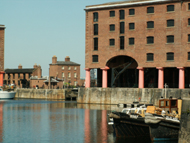
The Liverpool of to-day owes much to
the construction in 1846 of the "Albert Dock"
a stunning architectural triumph, and the construction
of numerous wet and dry docks. Liverpool soon became
a treasure house of precious cargoes from all over the
world and the Pier Head landing stage is reputed to
be the largest floating quay in the world.
Liverpool expanded significantly in the
19th century and a number of major buildings were constructed
(St. George's Hall, Lime Street Station etc.). When
the American Civil War broke out Liverpool became a
hot bed of intrigue. The last confederate ship, the
CSS Alabama, was built at Birkenhead on the Mersey and
the CSS Shenandoah surrendered there. Liverpool was
granted city status in 1880.
Liverpool's Town Hall was designed by
John Wood of Bath. Later James Wyatt was responsible
for enlarging the building by the addition of a Dome.
Other notable buildings are the restored Museum and
Walker Art Gallery. The old parish church of St. Nicholas
was rebuilt in 1952, except for the tower of 1815. This
church stands in a memorial garden facing pierhead.
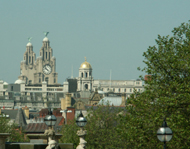
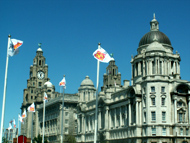
Standing on the Pierhead for almost a
century are the Three Graces. Rising to nearly 295ft
is the Royal Liver Building which has two towers surmounted
by the legendry Liver Birds, the Cunard Building and
the Port of Liverpool Building. The idea for these three
majestic buildings was conceived and they were constructed
as visible symbols of Liverpool's international prestige.
To-day, these three buildings define one of the worlds
most recognizable skylines.
Sir Giles Gilbert-Scott designed
the New Anglican Cathedral, it was begun in 1904, it
has a wonderful organ and fine stained glass windows.
In stark contrast is the new Roman Catholic Cathedral
of Christ the King, with its impressive interior lanterntower
of multi-coloured glass. This great modern-day Cathedral
was consecrated in 1967.
During World War II there were eighty
air-raids on Merseyside, with an especially concentrated
series of raids in May 1941 which interrupted operations
at the docks for almost a week. Although 'only' 2,500
people were killed, almost half the homes in the metropolitan
area sustained some damage and 11,000 were totally destroyed.
John Lennon, one of the founding members of The Beatles,
was born in Liverpool during an air-raid on October
9, 1940.
Significant rebuilding followed the war,
including massive housing estates and the Seaforth Dock,
the largest dock project in Britain. However, the city
has been suffering since the 1950s with the loss of
numerous employers. By 1985 the population had fallen
to 460,000. Declines in manufacturing and dock activity
struck the city particularly hard.
Liverpool has a strong maritime history
that goes back over 800 years and there is much that
bears witness to this illustrious seafaring prowess
to be seen in the town and the museums.
This enterprising City truly has
something for everyone. If it is peace and quiet that
you seek, then it is to be found in the wonderful countryside
that lies just a stones throw from the city. If it is
sea and sand then that too can be found close by. Exciting
shops are all around and there are numerous pubs, inns
and restaurants many of which are renowned for their
international cuisine and some that offer delicious
'home-cooked' dishes, all though provide the visitor
with a unique eating experience.
|